
How to Design Theater Seating, Shown Through 21 Detailed Example Layouts

Audience sightlines, accessibility and acoustics all make theater seating a hugely precise art. As part of their set of online resources for architects and designers, the team at Theatre Solutions Inc (TSI) have put together a catalog of 21 examples of theater seating layouts. Each layout is well detailed, with information on the number of seats, the floor seating area and row spacing. These layouts fall under three general forms; to supplement this information, alongside TSI's diagrams we've included the pros and cons of each type, as well as examples of projects which use each format. Read on for more.
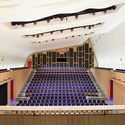
How to Design Theater Seating, Shown Through 21 Detailed Example Layouts - Image 23 of 32How to Design Theater Seating, Shown Through 21 Detailed Example Layouts - Image 24 of 32How to Design Theater Seating, Shown Through 21 Detailed Example Layouts - Image 27 of 32How to Design Theater Seating, Shown Through 21 Detailed Example Layouts - Image 32 of 32How to Design Theater Seating, Shown Through 21 Detailed Example Layouts - More Images+ 27

1. End Stage

How to Design Theater Seating, Shown Through 21 Detailed Example Layouts - Image 11 of 32
Courtesy of Theatre Solutions Inc.

In the End Stage form, the entire audience faces the stage in the same direction. Sightlines are kept simple, making these layouts perfect for lectures, films and slide-based presentations. They also fit well into conventional rectangular plans.

How to Design Theater Seating, Shown Through 21 Detailed Example Layouts - Image 10 of 32
Courtesy of Theatre Solutions Inc.

However, End Stages are not overly successful at creating a close relationship between performer and spectator. Theatres in this form also can’t be too large due to acoustic limits.

How to Design Theater Seating, Shown Through 21 Detailed Example Layouts - Image 2 of 32How to Design Theater Seating, Shown Through 21 Detailed Example Layouts - Image 3 of 32How to Design Theater Seating, Shown Through 21 Detailed Example Layouts - Image 4 of 32How to Design Theater Seating, Shown Through 21 Detailed Example Layouts - Image 5 of 32How to Design Theater Seating, Shown Through 21 Detailed Example Layouts - Image 6 of 32How to Design Theater Seating, Shown Through 21 Detailed Example Layouts - Image 7 of 32How to Design Theater Seating, Shown Through 21 Detailed Example Layouts - Image 8 of 32How to Design Theater Seating, Shown Through 21 Detailed Example Layouts - Image 9 of 32How to Design Theater Seating, Shown Through 21 Detailed Example Layouts - Image 12 of 32How to Design Theater Seating, Shown Through 21 Detailed Example Layouts - More Images+ 27

Examples:

The Blyth Perfoming Arts Centre / Stevens Lawson Architects

How to Design Theater Seating, Shown Through 21 Detailed Example Layouts - Image 23 of 32
The Blyth Performing Arts Centre / Stevens Lawson Architects. Image © Mark Smith

Theatre Agora / UNStudio

How to Design Theater Seating, Shown Through 21 Detailed Example Layouts - Image 24 of 32
Theatre Agora / UNStudio. Image © Iwan Baan

Municipal Theatre of Guarda / AVA Architects

How to Design Theater Seating, Shown Through 21 Detailed Example Layouts - Image 25 of 32
Municipal Theater of Guarda / AVA Architects. Image

2. Wide Fan

How to Design Theater Seating, Shown Through 21 Detailed Example Layouts - Image 13 of 32
Courtesy of Theatre Solutions Inc.

In this form, theatre seats are placed within a 130-degree angle of inclusion. This brings in the audience closer to the performer, establishing a more intimate experience.

How to Design Theater Seating, Shown Through 21 Detailed Example Layouts - Image 15 of 32
Courtesy of Theatre Solutions Inc.

This angling also means that the form is better geared towards speech-related performances. Film presentations would be trickier in these spaces, with screens requiring proper positioning – perhaps further back from the stage, to compensate for seats that find their sightlines distorted. 

How to Design Theater Seating, Shown Through 21 Detailed Example Layouts - Image 18 of 32
Courtesy of Theatre Solutions Inc.

How to Design Theater Seating, Shown Through 21 Detailed Example Layouts - Image 14 of 32How to Design Theater Seating, Shown Through 21 Detailed Example Layouts - Image 16 of 32How to Design Theater Seating, Shown Through 21 Detailed Example Layouts - Image 17 of 32How to Design Theater Seating, Shown Through 21 Detailed Example Layouts - Image 19 of 32How to Design Theater Seating, Shown Through 21 Detailed Example Layouts - More Images+ 27

Examples:

National Grand Theatre of China / Paul Andreu

How to Design Theater Seating, Shown Through 21 Detailed Example Layouts - Image 26 of 32
National Grand Theater of China / Paul Andreu

Ulumbarra Theatre / Y2 Architecture

How to Design Theater Seating, Shown Through 21 Detailed Example Layouts - Image 27 of 32
Ulumbarra Theatre / Y2 Architecture. Image © Peter Clarke

Limoges Concert Hall / Bernard Tschumi Architects

How to Design Theater Seating, Shown Through 21 Detailed Example Layouts - Image 28 of 32
Limoges Concert Hall. Image Courtesy of Bernard Tschumi Architects

3. ¾ Arena

How to Design Theater Seating, Shown Through 21 Detailed Example Layouts - Image 20 of 32
Courtesy of Theatre Solutions Inc.

¾ arenas see a 180-270-degree angle of inclusion. Hearing and visual contact between spectator and performer is improved, and as audience members can see each other when facing ahead, the sense of inclusion is increased even more.

How to Design Theater Seating, Shown Through 21 Detailed Example Layouts - Image 21 of 32
Courtesy of Theatre Solutions Inc.

However, conventional film presentations are almost impossible and would require an alternative screen layout, such as a number of smaller screens arranged throughout the space.

How to Design Theater Seating, Shown Through 21 Detailed Example Layouts - Image 22 of 32
Courtesy of Theatre Solutions Inc.

Examples:

Han Show Theatre / Stufish Entertainment Architects

How to Design Theater Seating, Shown Through 21 Detailed Example Layouts - Image 29 of 32
Han Show Theatre / Stufish Entertainment Architects. Image via Stufish Entertainment Architects

Dee and Charles Wyly Theatre / REX + OMA

How to Design Theater Seating, Shown Through 21 Detailed Example Layouts - Image 30 of 32
Dee and Charles Wyly Theatre / REX + OMA. Image © Iwan Baan

Hardelot Theatre / Studio Andrew Todd

How to Design Theater Seating, Shown Through 21 Detailed Example Layouts - Image 31 of 32
Hardelot Theatre / Studio Andrew Todd. Image © Martin Argyroglo

4. Other Layout Options

While the above three tend to be the most common forms of seating layout, they are by no means the only ones. Further options include Arena seating where the audience wraps around the stage a full 360 degrees, common for extra-large theaters like the Royal Albert Hall, and the Vineyard style where seats are arranged in cascades of mini-blocks of varying levels, including the rear of the stage, as seen in the Hamburg Elbphilharmonie.

How to Design Theater Seating, Shown Through 21 Detailed Example Layouts - Image 32 of 32
Hamburg Elbphilharmonie / Herzog & de Meuron. Image © Iwan Baan

Or even more differently, Bijlmer Park Theatre is a hybrid between End Stage and ¾ Arena, with flexible pull-out seating turning it from one to another, while The Wave’s seating takes after its namesake.

For more detail on designing auditoriums, including info such as seat spacing and the slope of the auditorium, check out TSI's comprehensive article here.

Originally published on November 16th, 2016; updated on November 4th, 2019. 

About this author
Cite: Sharon Lam. "How to Design Theater Seating, Shown Through 21 Detailed Example Layouts" 27 Nov 2019. ArchDaily. Accessed . <https://www.archdaily.com/799379/how-to-design-theater-seating-shown-through-21-detailed-example-layouts> ISSN 0719-8884

如何设计剧院座位,21个细部案例

You've started following your first account!

Did you know?

You'll now receive updates based on what you follow! Personalize your stream and start following your favorite authors, offices and users.